CHECK OUT OUR MOST RECENT HOOKS

  • THE BEAUTY OF A DEV DECK

    Babette N.


    So, you’re on your game development journey! That’s awesome!

    A very common process in creating games is a development deck, or a dev deck, which helps you and your team track progress and stay organized. A lot of people mistake their function, so we’re going to go over what a dev deck actually does!

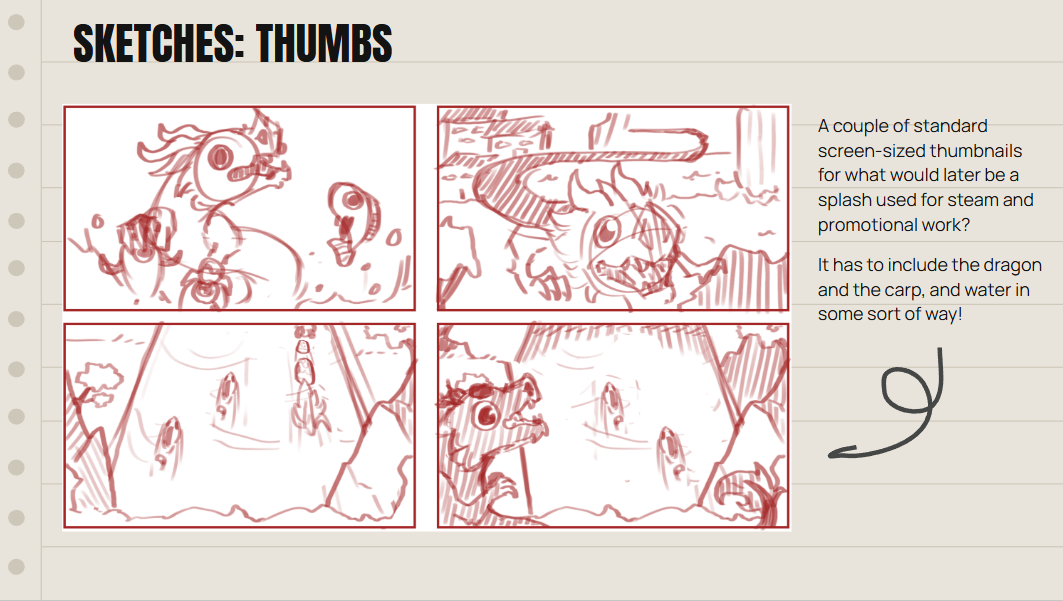
    An example of a slide for a dev deck I made in relation to art for a miniature portfolio game!

    A dev deck is far more important internally than for your viewers. It’s a way to track progress throughout the process of your game’s creation. Some people create a dev deck that updates by each goal met, others by time (week, day, month updates). Personally, I like to do weekly updates since it tracks exactly what I’ve gotten done in a specified amount of time, and highlights any new features or addons.

    It’s also motivation for the unmotivated. A lot of folks may struggle to keep working on a project unless there’s tangible small-scope goals and visible progress met, and that’s where a dev deck shines. You can easily go back to see progress, and set small goals with yourself in accordance to a planned schedule or kanban/scrum board system.

    Also in the slides, an active tracker about where we’re at and what’s being done

    At the end of the day, a dev deck should be telling other members of the team what is being implemented and done throughout the specified time period. Because of this, it doesn’t have to look nice! Just think of it as a blog post that you make to talk about the system.

    Dev decks should have a TON of WIP and concept phase work! They are literally updating from 0, so you’re not expected to be showing off high gear work.

    A lot of dev decks are shared publicly to keep fans in the loop, but this can also just purely be separated into update VLOGS, posts, or videos to keep things cleaner. Dev Decks are a little more nitty gritty and not necessarily in layman’s terms, and may include issues and bugs that you don’t want to share to your player base. However, it is still important to track these issues (especially before QA testing and external demos) so you need to put these somewhere — and that’s where a dev deck comes in!

    More dev deck posts with INTERNAL notes to the team

    Truly, a dev deck is what you make of it, and it should be made in a way most useful to you and your team. A lot of folks also just generally like reviewing dev decks to preview an upcoming game, or as junior designers themselves, and by providing a resource we continue to allow the open-source of game development processes to grow.

    Jobs may also enjoy looking at your processes and want to preview exactly how you break things down and lead a team, and if that’s the case it’s always nice to hold onto a well-organized example of that work!

    A dev deck is only as strong as the team wielding it, so good luck crafting!

  • XP SUMMIT TORONTO 26!

    Babette Norton


    Hey gang! Long time no chat!


    This week, I had the pleasure of visiting the XP Summit Toronto again for 2026, located once more at the Hyatt in Toronto. The venue is a great size, and although it can be a bit tough at times to navigate to the corners to find some hidden treasures, the indies that made their way out again continues to showcase the heart in Toronto. Or maybe I’m just biased (go Ontario!).

    I arrived at the venue a little bit later than last time (running last minute errands wahoo), grabbed a coffee, and immediately hopped into some meetings. Although it’s not the most organic way of networking and I definitely recommend just walking around, it’s great to do 1 on 1 meetings for specific stuff or busy people.

    As usual, everyone was an ABSOLUTE delight. It’s always a pleasure to just geek out about the industry, and the passion behind the games being made always sparks hope in such a tumultuous environment. Some of my favourites will be posted soon, but I’d be a fool not to give an immediate shoutout to Once there were cats and Wheat & Wrath. Both have such incredible direction and gameplay, you’ve got to wishlist em!

    We also got to attend the Game Awards for 2026! I was with the crew at Noodle Goose and some other delightful folks including cosplayers, actors, and influencers. From left to right: VibeyVee, Mark, Alex, Tagan Mani, RayGreyCosplay, Clement Goh, Kevy Oh, Karen Mak, LT kanada, Randy, Tech Goggles, and Babette Norton.

    The whole gang at the Canadian Game Awards! Thanks to Giovanni McLeish for the photo!

    The events being back to back almost knocked me dead, but I’d never say it’s a bad time. The event can be tiring if you’re an introvert or extrovert, so make sure to rest lots after a successful day/night!

    My main advice for these events is to bring business cards. Sometimes meeting folks happens on a dime, and having a quick way to connect is so fundamental. Another general piece of advice is just have fun; starting every conversation with “Are you hiring?” just isn’t a fun way to talk.

    I got my ticket through Amir Satvat’s Always Supporting The Game Community (ASGC.GG), so I highly encourage newbies or folks in financially rough times to always keep an eye out for the free ticket raffles. It’s how I’ve been able to attend the XP events I otherwise simply could not afford.

    Another great way to enter these events is through volunteering! Volunteers don’t have access to MeetToMatch (the B2B meeting platform), but you can meet people in the industry very easily and then during breaks roam the event.

    Our main dude Michael Wilson (Research Lead at ENTRY LVL) volunteered today!

    Most importantly than anything else, take in the opportunity to see the indie space as it’s made to be: celebratory and creative. There are such unique and new ideas spawning from the Toronto game space, I really do hope folks make the trip out to see it in it’s glory.

  • GDC PREP NOTES FROM THE PHONE OF J. ISAAC GADIENT

    J. Isaac Gadient


    GDC PREP
    Saturday, March 7, 2026
    9:06 AM
    I have put off:
    ◦ Packing
    ◦ Doing Laundry to even have clothes to pack
    ◦ Trying on outfits to see if i even own anything fancy enough for the awards shows that still fit on my fluctuating-in-size body
    ◦ Doing Dishes (cannot leave the sink full for my spouse while i’m gone)
    ◦ Finalizing my GDC talk schedule, so many good sessions I have at least two conflicts each day M-F
    ◦ Actually booking any boba chats, past “hey we should hang out or at least high-five eachother on our way to the next thing”
    ◦ Getting those cute pokemon stickers from the local game shop to give to my friends i see irl as gifts
    ◦ Pre-checking in for my flight (which leaves out in just fifteen hours)
    ✓ Starting this piece for ENTRY LVL

    9:54AM
    ::tv show voiceover voice::
    I bet you’re wondering why I’m in my basement going through piles of stuff I haven’t looked at let alone touched in months *just in case* there’s anything useful for my upcoming week in California *even though* virtually nothing on the list above has gotten accomplished.

    LOOK STRAIGHT TO CAMERA, BREAK FOURTH WALL

    ISAAC
    (Pleasantly, professionally)
    Hi, i’m J. Isaac Gadient. And I have ADHD.

    11:12AM
    Just realized I haven’t documented my GDC prep with any photos* or videos yet at all.


    Here’s what I could bear** to part with, so I’m headed to my local game shop to sell these to raise some funds*** so I can eat**** next week.

    *I am a photojournalism school dropout (2003-2005, WKU).
    **I’m not thrilled about this, but one of the reasons i’ve always kept physical media (vinyl when i was in the music industry, now games) is so that when times are lean I can sell my things to get by, even if only just.
    ***https://bsky.app/profile/jisaacgadient.bsky.social/post/3mfwnqgwcss2e
    **** between laundry and getting ready to run this errant my best friend of twenty-five years called and when I mentioned someone from Facebook Marketplace was coming over at 2:30PM to buy one of my bass guitars, he said he’d buy my some gyros or falafel for dinner one next next week if I’m broke so I don’t have to break my promise not to use credit cards I cannot pay off.

    12:23PM
    Just realized I haven’t eaten yet today

    1:22PM
    Mission: NOT accomplished.

    All this and r$2.28 store credit.

    5:58PM
    Dishwasher’s running, laundry’s dried and in a hamper to be folded and packed in my suitcase, and I’ve just had a lovely ragu my spouse made from scratch (as well as handmade pasta) while we watch the series nine finale of Bake-Off, and I just got this email:

    But—nothing I can do about it but wait, right…?

    Well. I hope there *is* something I can do about it.

    If my plane is actually on time and lands at SFO at 9:40, then i’ll have fifty minutes to get a lift to Moscone Center (a 16-minute drive), register & get my badge, and hoof it to West Hall and find a seat. I think this is technically possible, but I never like cutting it this close. If I stay overnight in Chicago (is American Airlines paying for my hotel? My transportation there and back to O’Hare?) and wake up Monday morning and *that* flight in cancelled…I will be very sad.

    8:01PM
    Anyways, I’m packed now. Never got to update my portfolio, which honestly is a big reason I am going*. So I feel a little silly about that. I suppose I should pack my laptop and work on it in my hotel during my overnight layover.

    *I got some friends and colleagues to give me notes so I could optimize my website before I bring it to the *absolutely stacked* Narrative Portfolio Review happening Monday:

    8:42PM
    No callback from American Airlines customer service yet (colour me surprised), so I suppose there is only *one* thing I *can* do:


    Hopefully I get some good sleep before we have to wake up at 5AM…and hopefully AA (American Airlines, not Alcoholics Anonymous) will be comping my accommodations tomorrow night in the windy city.


    All image credits to J. Isaac Gradient unless captioned otherwise.

  • MDEV 2025

    J. Isaac Gadient


    Madison, Wisconsin: An hour west of Milwaukee and half its size; two hours west of Chicago and a tenth its size. But Madison does boast one feature (in addition to the best cheese curds in the world): A robust local game development scene. To name a few studios: Raven Software, Respawn, PUBG, Filament Games, and Lost Boys Interactive.

    Ben Kvalo (CEO of Midwest Games, formerly Lead Program Manager of Games at Netflix) has stepped up this year as the new Board President of the Wisconsin Games Alliance (WGA). Kvalo brings new energy and a new approach to the Midwest’s largest video game industry-focused event. 

    Most significantly, the “show”, as Kvalo called it all weekend, is now two (2) days long instead of just the one as it always had been. MDEV25 took place on November 7-8 at the Alliant Energy Center here in Madison, WI. There was a kickoff social the night before as well that had some talks and drinks—a bit of a “red carpet” style event. Some folks dressed up in formalwear, others wore casual attire, and others still came in full cosplay! The celebratory preconference set the inclusive tone of the weekend.

    The conference had no trouble expanding to fill two days of content—there were loads of amazing talks by developers, keynote speakers, and indie games on display at the showcase. The opening talk by Gordon Bellamy (Gay Gaming Professionals, Designer on the original Madden games) was dense in the best way. Bellamy dropped so many nuggets of wisdom in this single talk that I could barely keep up with writing them down in my notebook. One gem I was able to capture was that “Wisdom compounds when we honor where we come from.” This got me to stop thinking, “Why is this guy from D.C. who lives in California speaking at a conference in and about the midwest?” I felt invited to feel enough where I was—indie and in-between the coasts. He told us: “You don’t need permission from anyone to do this.”

    The most profound moment of Bellamy’s keynote was when he asked the entire MDEV crowd to get out their phones, open up LinkedIn, and hand their smartphones to someone next to them from another state. Some folks of course were reluctant to do so, but the energy in the room was buzzing. I met two new people, one of whom I spent some nice time with during the conference: A fellow writer, all the way from Arizona, who was able to attend thanks to a gifted pass from Amir Satvat’s Gaming Community.

    The other keynote speaker, Chris Melissinos, mused that web-based gaming could be the future of our industry thanks to HTML5. Instead of purchasing more consoles, we could all use the hardware we already have: Our computers, TVs, and smartphones. In addition to discussing the future, he talked about the past (he is, after all, a video game archivist), and brought out onstage one of the original PONG motherboards, which honestly impressed me more than I would have guessed. Neat to be in the same room with such a material piece of game development history.

    As a narrative designer myself, I was delighted there were several talks on writing. Quinn Elmer (previously Lost Boys Interactive and The Initiative) finished his trilogy on The StorytellingToolkit with adroitness and aplomb. He even put on his (metaphorical) turtle neck to get scholarly and technical with us.

    The focus for this third and final installation of The Storytelling Toolkit was on implementation. Elmer used Unreal Engine’s Blueprints as an example, since that’s what he used when he was working on the cancelled Perfect Dark reboot and suggested Lua as a relatively simple programming language that narrative designers could learn that would teach applicable skills for scripting in whatever languages and tools studios may have them use.

    Perhaps the most interesting talk I caught was a panel of folks who brought to life the game Powwow Bound: A Menominee Homecoming, a narrative adventure created by a partnership between 

    Nebraska Public Media and PBS Wisconsin. The Game Designer Jacob Schwitzer and Writer Justin Eagle Gauthier were on the panel and discussed the deep cultural importance of representing a contemporary Native experience with respect and authenticity.

    To catch more excellent words from all of these keynote speakers, keep your eyes peeled: This will be the first year since the first MDEV that all the talks will be uploaded to YouTube. Keep a look out for WGA getting those edited and posted (I assume sometime early next year).

    I didn’t delve deeply into the indie games showcase because—good problem to have—I had so many friends at the conference! I got to enjoy friends old and new from Chicago; I had impromptu meetings with devs I’d been connected with on LinkedIn; I got to see some local Madison gamedevs that I don’t often see the rest of the year; and I was able to speak with some of the presenters whose talks inspired me.

    The game I did spend the most time with was Midwest Goodbye. The devs were kind and excited, and explained that the title was chosen from many adjectives and nouns on a whiteboard, and they had to build something that it evoked for them, jam-style. The combination of 2D hand-illustrated characters and 3D environments was fun and inviting. The setting and premise of the story was pleasant—I’m a sucker for slice-of-life games. 

    As a former marketing volunteer for WGA, I can say objectively that the best thing the team did for promoting MDEV2026 was to put on a truly amazing MDEV2025. This year was exciting and cozy at the same time for me, and that’s all I ever want out of life. Some familiarity, some freshness; learning and sharing; having fun and getting down to business. I’m hopeful for the Midwest as a haven for gamedevs.

    DISCLOSURE: The author of this article volunteered from April to October as a member of the marketing committee for the WGA.

    P.S. There was a really lovely talk, “The Freelancing Life,” by author and game designer Matt Forbeck that bookended my MDEV experience.

    (PICTURED: Just so everyone knows the kind of badass you’re dealing with when Matt Forbeck gives a talk…He yapped in front of this projection of his nonexistent powerpoint. Almost an hour of freestyling on freelancing.)

    Matt’s awesome talk didn’t make it into my main piece, but these most gilded nuggets are too good to not impart!

    TO SURVIVE THE FREELANCING LIFE:
    1) Set up an S Corp for tax purposes.
    2) Diversify your income streams; even in different industries.
    3) If you want to tell stories with your writing, you have to learn to talk to people first.
    4) ALWAYS ask for more money.
    5) Explain WHY they should pay you more money.
    6) Cut your expenses.
    7) Read every contract is if it were written by your WORST ENEMY.
    8) NEVER agree to any job “paid upon publication.”

    and this trinity:
    A) Don’t be a jerk;
    B) Show up on time;
    and C) Do what you say you’ll do.

  • XP VANCOUVER

    Babette Norton


    Vancouver is one of Canada’s great media hubs; home to a majority of the animation and film industry, Vancouver also boasts a massive chunk of the games industry as well.

    This weekend was the XP Biz & SIGNALS joint event in the heart of the city. In two different downtown venues, October 3rd and 4th featured a true celebration of games, XR/VR, and tech as a whole.

    Once again, I was lucky enough to have been given an all access pass courtesy of Amir Satvat (wonderful human – go check him out!!). This time however, the event was a little further from home, and I took the 5 hour flight down to network and talk about my experiences in the industry.
    There were a lot of familiar faces – Simply Sweet Games showcased Criss Cross Castle again at the event following their soft launch, INSERT COIN did several talks throughout the first day, and

    Then there was all the excitement of the new faces and studios I got the chance to meet. I loved Buffalo Buffalo’s game FRESH TRACKS, a VR and non-VR friendly rhythm game where you ski alongside the tracks to help the gods. MONSTERHEARTS: Welcome to Drowned Lake scratched a narrative itch I had been having, and the unique artstyle captured me immediately.

    Outside of games, there were also some awesome set-ups and interactive media projects on display. Binga! Brands had this super cool AR toy collectible that I loved interacting with, and the project came so much from the heart that it was awesome to see. There were movie-esque projects too, like the Lily Project setup which retold a more modern surveillance-heavy story from Iran with a focus on Lady Macbeth.

    I think one of the bigger questions folks may have is “Is this worth attending”? As it’s known, a lot of events in the industry that are B2B have a bit of a steeper price point – one that’s not always accessible for those searching for or out of work.

    All in all, I’d say within Canada XP Gaming’s events are not just top notch, but also extremely well known by the industry. Big names like Riot Games, Serenity Forge, and lots of veterans from groups like EA and Ubisoft come to these events, and especially as an entry level searcher, these events are critical in making connections within the industry. Even if you don’t land a contract at the event, you are sure to meet people who you will connect with along your gamedev journey.

    Another important topic of this is that these tickets are more accessible than ever. Giveaways through Amir Satvat’s Community on LinkedIn are constant; it’s how I had all 4 of my attended events comped. Outside of that, schools often have discounts or are able to partial pay for tickets, allowing you to get them at a significant discount.

    MIGS is the next big event; one I went to about a year ago (and my first ever game event in Canada)! I hope to continue seeing faces and admiring how everyone pushes this industry to be smarter, more inventive, and more accessible.

  • THINK OF GAMES AS YOU TRY TO GET INTO THE GAMES INDUSTRY

    Franco E. Pacho


    Recently, I’ve been thinking about portfolios, more specifically on how we build one. Since I am in the process of updating my writing portfolio. 

    By now, if you are aiming to work at the gaming industry you must have heard (and read, even here at ENTRY LVL) some advice to build your portfolio or perhaps attended Portfolio Reviews. If not…, do it. RIGHT NOW. 

    The most common advice you get is “Show your best pieces”, “Work in various pieces as a unified project”, and “Show complete breakdowns”.

    Darksiders 3 | Scars (zone mood)

    Usually, the resume of the advice is “you must present a detailed version of what you can do while aligning what you are showcasing with the expected work of where you want to apply”, so you get more hits than misses; that and a good amount of luck. 

    And this is all advice that many can understand when it comes down to Art portfolios, since this is where the portfolio idea mostly comes from. Animation, Concept Art, also applicable to 3D. 

    But this does not translate well to some other Game Dev disciplines. 

    I approached my Narrative portfolio with this mentality. I wrote an interesting character, their Bio, their mechanics and how the player interacts with them, wrote barks and some dialogue. And then when I received feedback for it, I was hit with “This would be an automatic failure for any writer test you do”. 

    The reason: This character did not consider the limitations of systems and game design needs. This character spoke like this: “I/We are pleased with your help/service”. They told me this would be confusing, and if there were the plans for this character to have voice over, there would be complications on how to approach it for voice acting.  

    So, I had to dial the complexity back, rethink how the character I have already designed and rethink their voice. Same thing with the place where the player would encounter them. This was new to hear for a portfolio.  

    Not do you most complex pieces? Think of your budget? 

    When it comes to Design at least for Game, Narrative, Level, I learned a new advice for portfolio. Show you clearly know how “games work”. 

    1.Be mindful of UI  

    …like the number of words in each dialogue box or how you make a player clearly understand effects through clean and neat icons while traversing levels. 

    2. Be mindful of UX 

    The processing of information you give to each player, or how to dial up or down tutorials and pop ups so they don’t feel you are hand holding them, how you communicate this information. 

    3. Technical budgets 

    …since you can’t design epic pieces with crowds that would most likely crash your computer.  

    Example of a pretty looking but not so functional portfolio (my old one) 

    The breakdowns were completely different too, in Art portfolios, some notes and materials breakdowns with some timelines are great and explains the artist thought process when the art is done. 

    Breakdowns on design must show what you are trying to convey to the player in real time. And a lot of the times a portfolio for design roles will have screenshots of the behind the scenes with explanations of why the decisions were taken, sometimes it feels wrong since putting literal excel sheets on with ramblings of a eloquent concise madman. 

    I’m sharing this for anyone that has a great looking portfolio but with not-so-great explanation and thought process of the design choices taken. Try and look for points of your work when shows things a little too out for a budget you are aiming for things that shouts “Naughty Dog”, but you are applying to “We-are-3-people-and-a-dog” indie studio.  

    Start thinking how to replace just great pieces with great pieces that have actual thought on the collaborative effort of games. Show you can work with someone to reduce the cost and time of making a game from 4 years… to 2 years. So that we collectively can retire the awful saying that “it’s a miracle that games are made”. It makes us look kind of incompetent, you know?