
J. Isaac Gadient
Goodreads officially launched in January 2007.
This was a social media database website allowing users to catalogue their libraries, marking books as read, TBR (to be read), or DNF (did not finish).
You’ve probably never heard of Flixster from ‘06 or iCheckMovies from ‘09, but you’re likely familiar with Letterboxed, which launched six years after in February 2013, with hopes of becoming a “Goodreads for film.”
Backloggd launched 2020.
Interestingly, Backloggd was created after its developer was dissatisfied with the UI of backloggery.com, a site established in 2008 whose front page says, “Buy Less, Play More.”
Honorable mention: Minimap launched in 2017 in Korea and then globally in 2023.
Historically, a backlog was a log of wood in back of a fireplace, kept there to smoulder for days, to be used eventually:
“The whole economy of pioneer times depended upon the backlog. The backlog kept pioneer hearths[…]warm. The backlog was rolled into the back of the great fireplace in one end of the cabin. It was green. It sizzled and oozed sap, but it wouldn’t burn. It was backing for the firewood that kept the cabin warm. When it dried out enough to burn it was rolled forward and took its place as firewood.” —Sarah (Burlend) Allen
Sounds useful!
However, as regards video games, it’s obviously an issue.
❧
“Most important for a writer to read widely, enthusiastically. Writing is a consequence of reading & writing well is a consequence of reading well.”
— Joyce Carol Oates
“You should write because you love the shape of stories and sentences and the creation of different words on a page. Writing comes from reading, and reading is the finest teacher of how to write.”
— Annie Proulx
“If you want to be a writer, you must do two things above all others: read a lot and write a lot.”
― Stephen King
Why do I begin this piece about game developers’ video game backlogs with quotes about writing? Because I am a writer.
The analogy works, though: Rare anymore is the game developer whose (at least former*) days aren’t filled with playing games complemental to making them.
Although you could argue that here and there an outsider’s perspective could be useful, it pays to stay current. As games industry superstar Anna Megill says:
“I think the juniors are coming in with some of the best ideas. They’re the ones who are playing these new games, who are seeing the cutting edge stuff and who are willing to question things that I think, you know, we dinosaurs have just been doing for so long that if you just stop thinking about it in a way like, well, of course that’s how you make this.”
*It’s not uncommon to hear gamedevs say they don’t play games much anymore simply because they don’t have time: They’re too busy making them. But, as Mr. King said in his memoir/craft text On Writing, “If you don’t have time to read, you don’t have the time (or the tools) to write. Simple as that.”
So, playing games as a game developer can of course just be entertainment on its face—it stands to reason that people make games because they love games (and playing them). Also, like a musician who keeps up with the freshest songwriting or production techniques, developers can play games as a means of studying. Advancements in technology, innovative systems, novel mechanics, experimental methods of expressive narrative…these things do not happen in a vacuum. The industry is in constant conversation with itself in terms of development of craft. Certainly some trends are the result of synchronicity, but largely we inspire, explore, and borrow from each other in a kind of guild-like fellowship, towards the betterment of games as a still-maturing medium.
All that is to say: How’s your backlog looking, fellow gamedev?
Do you have games you’re looking forward to playing simply as a pastime? A way to connect with friends, or a reliable method of winding down and possibly vegging-out after a long workday?
I ask because I have a spreadsheet.
I play games with my spouse as a way to connect and have fun together. I try to suggest single-player, story rich games (my bread and butter), but my spouse says they “tend to be really sad,” and they’d rather play something “simpler and more fun.” Ouch. Right in the game writer specialization.
I share this because that’s about all the game-playing I do for fun. I’ve been so determined and focused on my game development journey that all 1000+ games I’ve amassed in the past three years have—almost without exception—been purchased for “research.”
I play PC games on my Steam Deck, and have a PlayStation 5 and a Switch. I tend to get physical copies of games so that I can trade them in at my local game shops once I’ve beaten them, with proceeds going toward my next game purchases.
I’m working my way through the pantheon of lauded narrative games: Red Dead Redemption 2, Mass Effect, The Witcher 3, God of War, Grand Theft Auto V, Skyrim, Half-Life 2, Deus Ex, Resident Evil 4, Horizon Zero Dawn, Alan Wake II, BioShock Infinite…The list goes on.
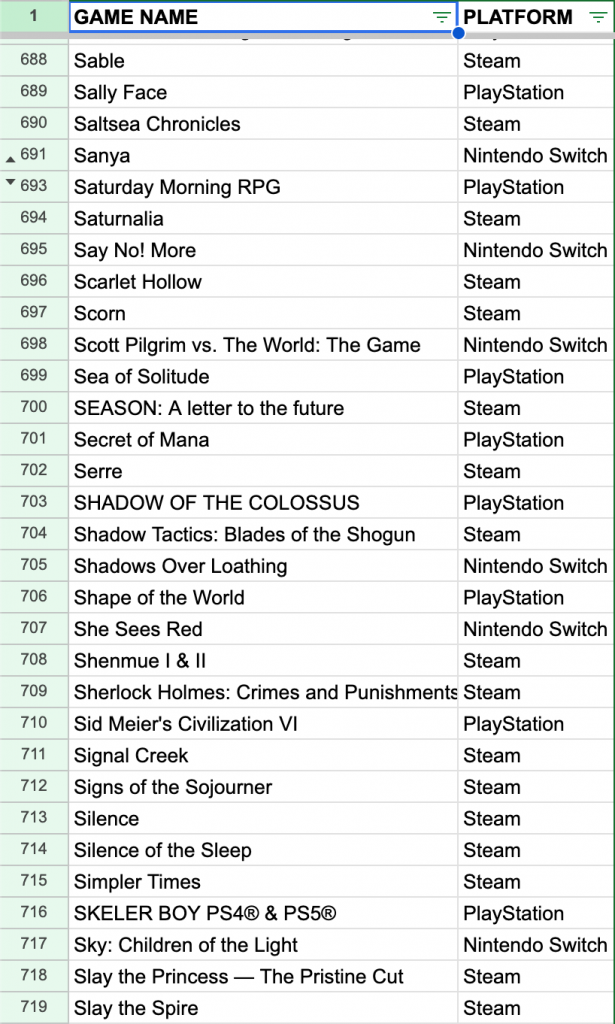
Literally.
It’s difficult to prioritize. Sometimes I’m lucky, and I am working on a project with a team for which I have an assignment that’s very direct: I was invited to join some folks making a mod for ▇▇▇▇▇ ▇▇▇▇▇▇▇ and needed to replay it. I had a freelance contract for a roguelike deckbuilder, so I watched Yu-Gi-Oh! and played Darkest Dungeon.
What’s trickier is the wide open space of generally getting better at my craft: The games canon. Some folks think there isn’t one; some folks think there shouldn’t be one. Well, there’s more than one.
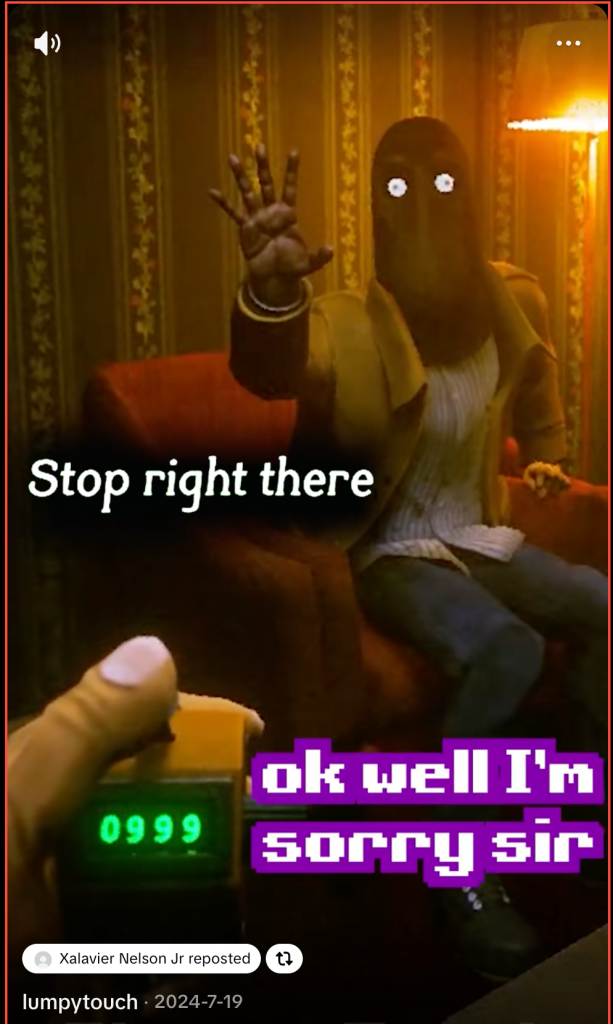
Hold it, Mx. Writer-pants. What are we even talking about here?
Q: Isaac. Please. What is a (video game) “backlog”?
A: I define my backlog as the games I own which I haven’t yet played.
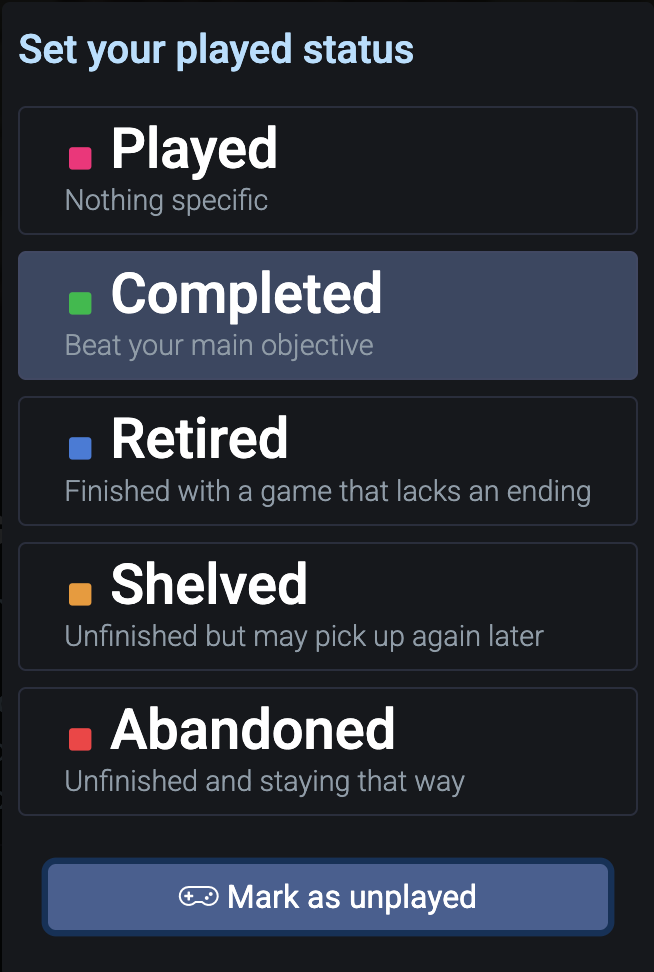
FWIW: This is how Backloggd allows their users to categorize “Played” games.
Q: Okay. Why do people have backlogs?
A: We didn’t used to as much. Amassing games was prohibitively expensive before the proliferation of indie games on digital storefronts. Now…Being on social media, seeing frequent sales, and having very little friction between desire and action results in libraries of games that outstretch our capacity.
Right, then: Back to me. (Yes, I am a Gemini, why do you ask?)
Not only do I feel the need to play all the highly-regarded story-rich games as a writer and narrative designer, but as a game dev in general I know that it’s not likely that I’ll ever be paid a living wage by working on games where I’m making all the huge decisions. Such as gameplay genre.
I stumbled onto player.gg today and answered this question:
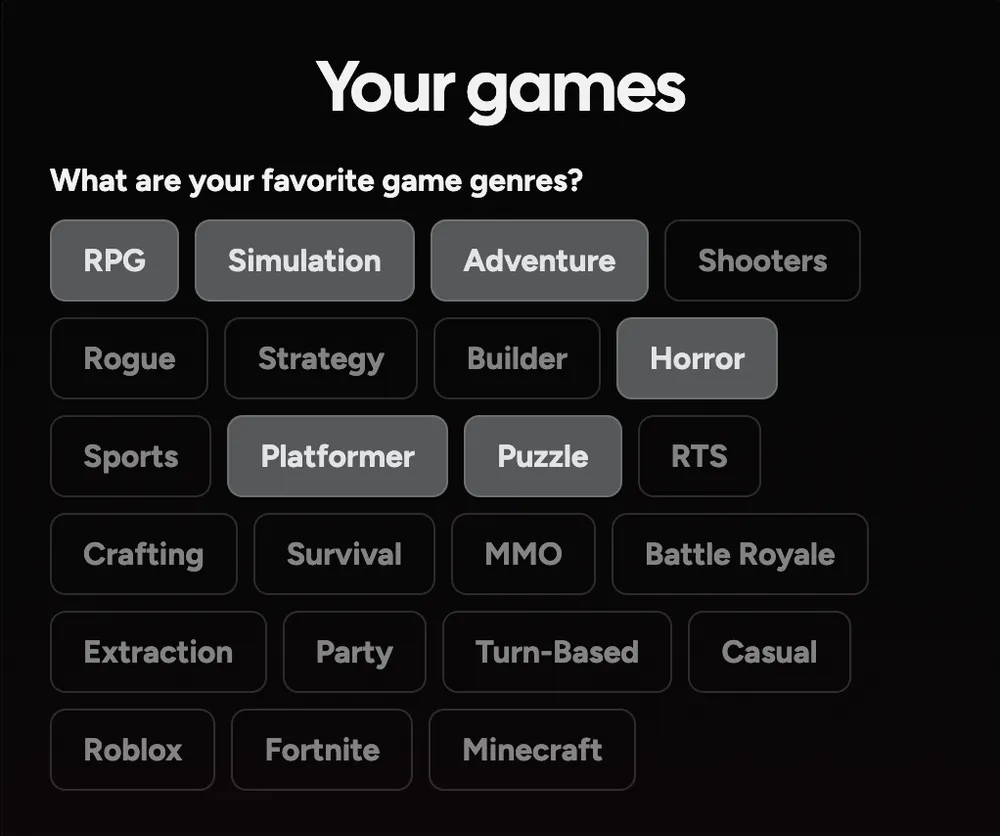
Did you know that Roblox, Fortnite, and Minecraft are GENRES now?
(Rogue as well—at least have the decorum to say “Rogue-like”.)
In order to be the most prepared, knowledgeable, and effective designer I can be, I should be familiar with all kinds of games. The onus is on me to play everything I can to be a well-read gamer and gamedev: Even genres I don’t like. Especially genres I don’t like—perhaps I’ve written them off so quickly and unfairly, that I don’t even know what they’re really about or how they feel.
That’s a lot of pressure, though. Some AAA games are 30+ hours long, even only considering just the critical path. If we average indie games at 15 hours playtime and guesstimate that my thousand-game backlog is 80% indies (because I’m a broke gamedev), then (800*15+200*30)/24=750 days straight I’d have to play video games. No breaks for sleeping or peeing or pooping or eating. Just video games.
Earlier in that FirstLook survey, they asked me how many hours a week I play games. I answered with the first, “0–7” bracket. I have a full-time day job again and I do actually write sometimes. Settling on the median of four hours per week, dividing my eighteen thousand hours of gameplay by four hours per week and then fifty-two weeks per year, it would take me eight-six and a half years to play all the games in my backlog.
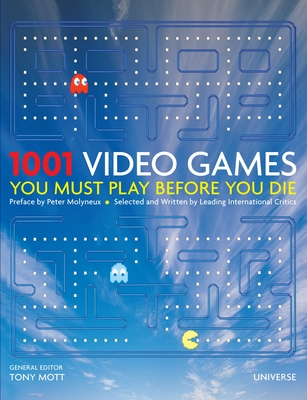
“Must!?”
Ahem.
…So.
What to do?
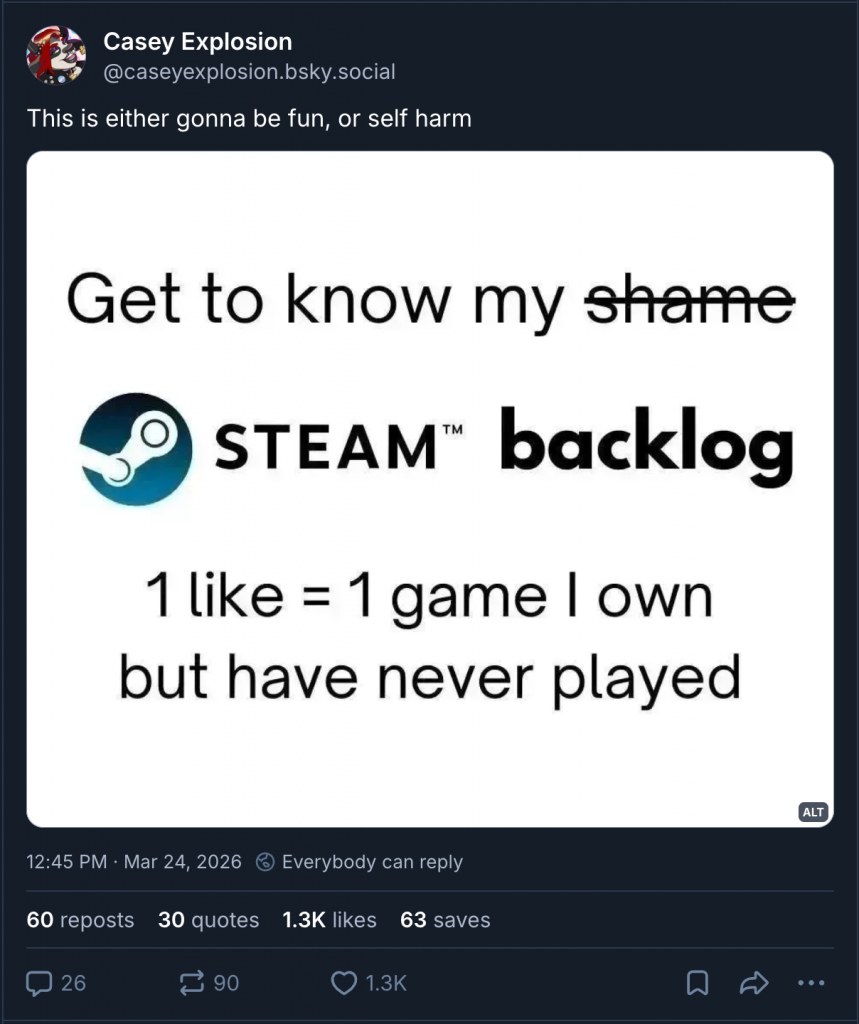
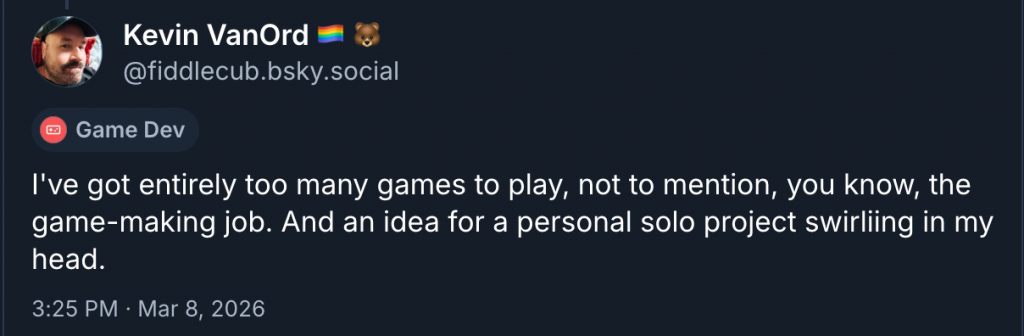
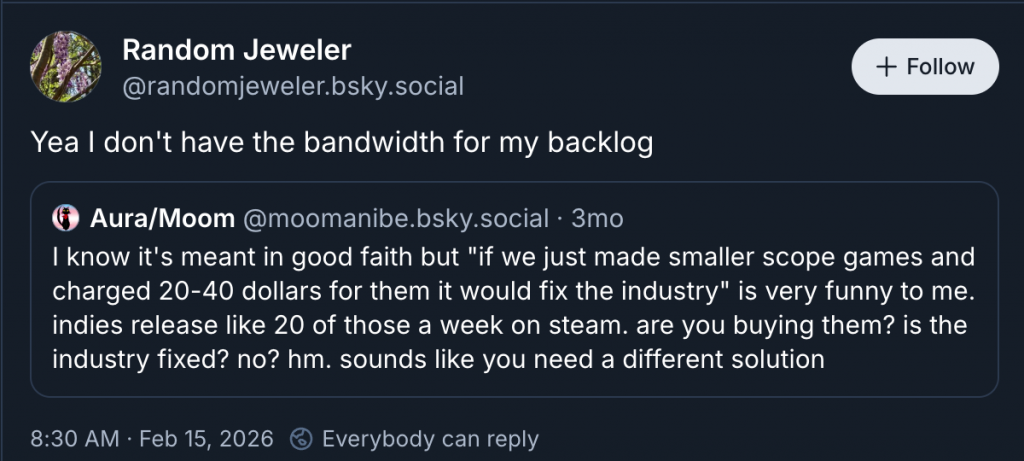
Writer David Dinaburg already covered a lot of what I have been wanting to say, back in 2023 in his piece “The Rising Case for a Videogame Canon: Recognizing cultural needs that arise in Brendan Keogh’s book The Videogame Industry Does Not Exist”
“[N]ow, in a climate of superabundance, when there is a new massive games [sic] released every week, the expectation or desire to try everything has turned a pleasurable hobby into a checklist-filled grindset. The sheer amount of videogames, their availability, and the inflated time commitment to play them have all swelled. The ability to play everything–even everything within a favored genre–has been obliterated.
Additionally, the expectation that you can and should “beat” a game or else relegate it to a swollen backlog—tagged and sorted and posted online—has expanded in parity with the rising sense that there might be a “cost-per-hours-of-fun” equation driving consumer behavior.
Most videogame platforms drip-feed dopamine to players with system-wide literal checklists of achievements and trophies that trigger bells and chimes after performing certain in-game actions, a stimulus/response drawn straight from Pavlov. That little ding can tether certain types of people to a particular videogames long after the enjoyment has withered.”
Games journalist and game writer Charlotte Huston offered twelve suggestions via Minimap for not getting overwhelmed by our backlogs:
1. Avoid Series Fatigue
2. Avoid Genre Fatigue
3. Break Up the Longer Games With Filler
4. Gauge a Game’s Time in Advance
5. Don’t Play Long Games Back to Back
6. Stop Juggling So Many Games at Once
7. Stop Replaying Games (For the Time Being)
8. Make It Routine
9. Get Off Social Media
10. You’re Going to Need a List
11. Avoid Installing Everything at Once
12. Evaluate Your Energy
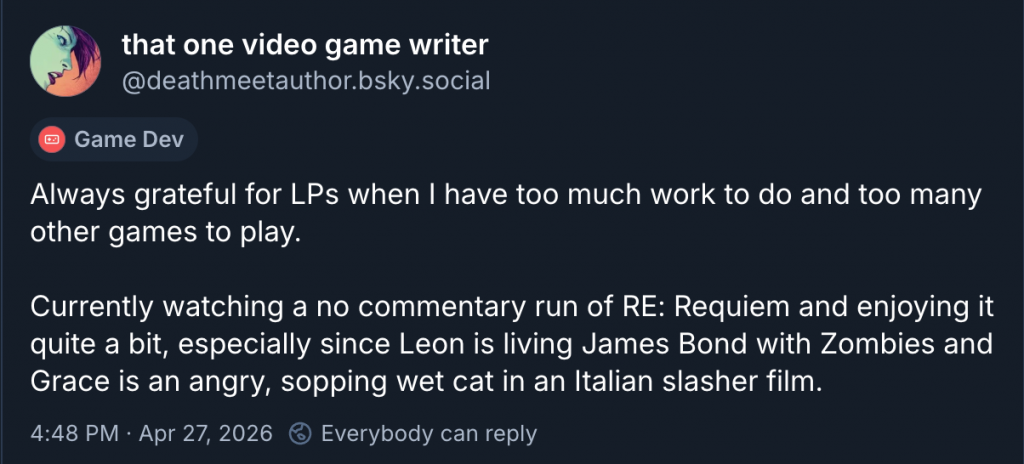
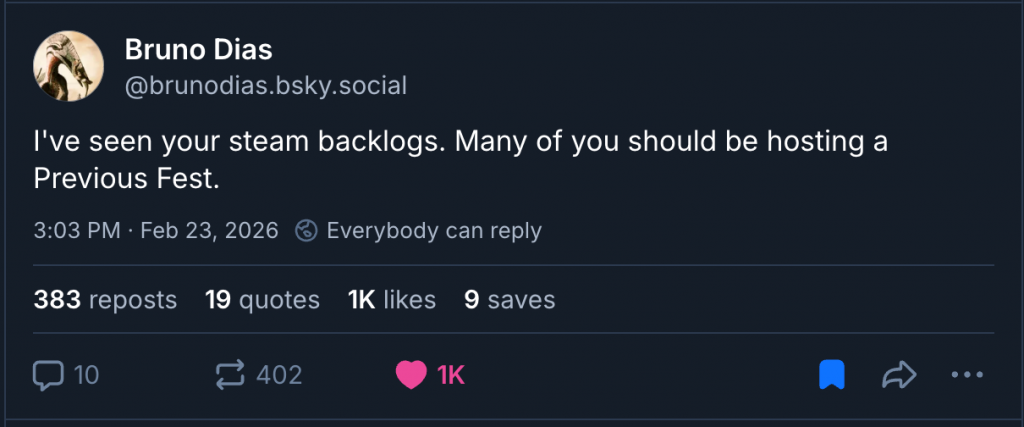
An important note, which may seem obvious to many of you: Longplays can be suitable simulacra for playing games yourself, and save not only money but time—folding laundry while watching all four Diablo games is on my June TODO.
❧
I had the pleasure of asking some game developers about their backlogs for this piece, and this is what they had to say:
“I feel… like a backlog is an inevitability. That’s probably the best word!
Both due to the monumental volume of excellent titles being released day in, day out, and also the fact that we’re all busy doing our best to exist let alone get a rattle on some good ol’ games.
It’s also not a dirty word! I like having a heap of titles sitting right there just for me, when I need ’em, and need ’em I will.
So yeah, of course on face value clearing a backlog can seem frustrating or daunting. But I think it’s better to look at it like, hey, here’s this heap of amazing games that I am still to play, and because there are so many I can choose EXACTLY what I’m in the mood for.”
—Alpha Chrome Yayo, Video Game Composer
“I feel sort of resigned. It’s endless, and I’ll probably never finish it, but I’m okay with that. What a cool world we live in that there are more wonderful video games than I have time to play.”
—Rachel Quitevis, VFX Artist
“We must not speak of the backlog.I think I’ve gotten pretty good at only buying games when I know I want to play them right now. No Steam sales FOMO making me buy something just because it’s on sale and “I might wanna play someday”. But I used to do that a lot and now I have a ton of games I’ve never even launched!”
—Stéfanie Grandchamp-Dubé, UX Game Designer
“I often find myself accidentally starting too many games before finishing others. Because of this, lately I’ve been playing a lot of indie game demos so I can keep an eye on games that haven’t released yet while still supporting indie devs.
A lot of games on my backlog are games I started and accidentally abandoned, because I want to give them the full appreciation they deserve.”
—chameleighon, Variety Streamer & Game Artist
“I don’t play a lot of video games to begin with. I’m a little picky with the games that I play, and even pickier with the games I buy. I have just 40 games [in my Steam library]. I have about maybe two…that i regret buying at some time. Besides that I don’t really have a backlog.
I’m “supposed” to be playing indie hits. People talk to me expecting that I would have this kind of shame: “Oh, what, you haven’t played [insert classic video game here]. Let’s say Half-Life 2. I haven’t played any of the Half-Life games. People will expect me to be ashamed. “Oh, how dare you even call yourself an indie developer if you haven’t played this classic video game. I never really felt like a part of the gamer community in any way. I never considered myself a gamer. I don’t really have those kinds of feelings about video games.
I don’t really have an interest in keeping up with the industry. I don’t really believe that I have any realistic chance being employed in the gamedev industry. I’m just working on…projects…to make stuff. I don’t feel a pressure to keep up. Sometimes I will think about getting a game to learn from it, but [the team and I] usually just like to experiment ourselves.”
—Ruipana, Indie Game Developer
“I have enough games in my backlog that I could not play a new release for the next decade and still game every single day.
I play waaaaay more games than I actually complete. My completion percentage for games is incredibly low, but I do play a ton of games every single year that I wouldn’t have been able to if I completed every game I played.
A lot of games in my backlog are honestly games that a lot of people would probably put up in the pantheon of games. Either I tried them and weren’t in the mood for them, or they simply passed me by and I just kept playing new stuff while my backlog kept growing. [T]hese games have been in the backlog for so long now, that it can be difficult picking one out from the list when I do feel like delving into my backlog, especially BECAUSE so many of them are seen as 10/10 games.
With how many amazing games come out each year, I think my backlog will keep growing forever, but I don’t necessarily see that as an issue: there’s nothing better than knowing that, even when there aren’t many games dropping at the moment, you always have some amazing games just waiting for you to finally hit “Start.”
—Jordan Mychal Lockhart, Senior Writer/Narrative Designer
I spoke with Nic Taylor aka Sab, the dev behind Game Quest: The Backlog Battler. His project’s demo recently went viral, getting ~3M views on social media.
The upcoming indie title pits you against yourself, in a way—its coding draws from your Steam Library and makes the games you’ve played the least…the most powerful enemies you fight against.
“It’s commentary on consumerism. [Its concept could be] getting into the psyche of certain people, like: “Maybe I could stop buying [so many] games. I have a feeling…a lot of game developers [won’t be] happy with my game.”
In addition to having something to say about consumer culture, Sab’s always had an affinity for meta-mechanics:
“As a kid, the moment Psycho Mantis reads the memory card in Metal Gear Solid? My mind exploded. I was like what the @#$%?! And I just couldn’t stop thinking about that. It’s like magic. It’s out of the box, it’s breaking the walls.
“And then more recently, Inscription—especially in Act 3 when the Archivist asks to read your hard drive and you have to give him the largest file.
“I’ve only been game developing for a year. I’m a web developer by trade. I was working on this other game, and I finished Inscryption so I was scrolling through my backlog. I thought, “Wow, so many of these games I haven’t played…[My backlog] feels like a boss. I just can’t defeat it.”
Sab then was inspired to pivot from that previous gamedev project and experiment with how an interactive experience could explore that sense of antagonism he felt from his backlog.
“I wanted to see if it was possible.I checked the local Steam API to get local playtime, but it wasn’t available. Then I found the web API had [local playtime] available, so yeah. It started then.
I asked Sab if he had a bunch of games lined up to play as research for his development, inspiration for gameplay and/or story genres. He gathered that I was being cheeky and called my bluff with a bit of earnestness:
“With Game Quest, I didn’t know what kind of genre at first…I just knew you had to use your library for something. I decided on arena/hack and slash. The confines of what I have, I don’t have as much freedom: There’s only certain metrics from the library I could use.”
“In all honesty, now that the game’s working – it’s still kind of a prototype—now is probably the time to do more research and get the playability down pat. There’s a lot of work for me to do.”
There’s a lot to be said for how we amass…things. When we play them, games are art. But for me, until then, they’re ones and zeroes, credit card debt, a massive TODO…But the impending challenge of time management and the threat of all that is yet-undone is only one portion of our Steam libraries. Most of us, anyway, do in fact play games. Some. Eventually.
“I’ve been watching a lot of streamers play my game. The best part is watching them reminisce about games they’ve played a lot…It brings me a lot of joy.”
❧
Oh yeah. Joy.
All this talk about working through a backlog almost had me forget the point of it all.
The joy of learning. The joy of experiencing. The joy of playing.
AND THEN, WHEN YOU’VE CAUGHT UP WITH ALL YOUR GAMES—
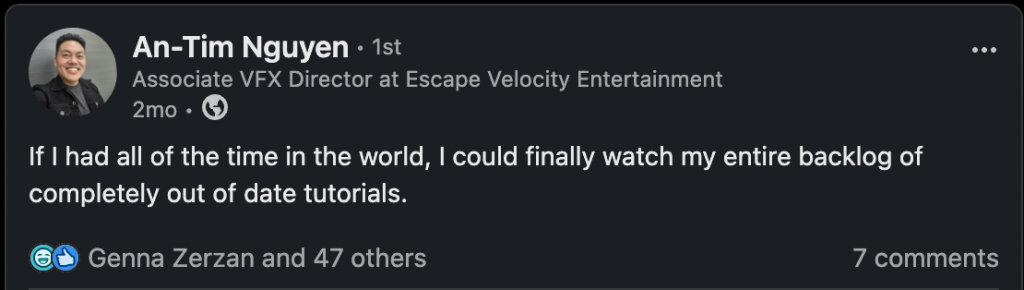
POV: Brackeys languishes in your Watch Later playlist.
Leave a Reply